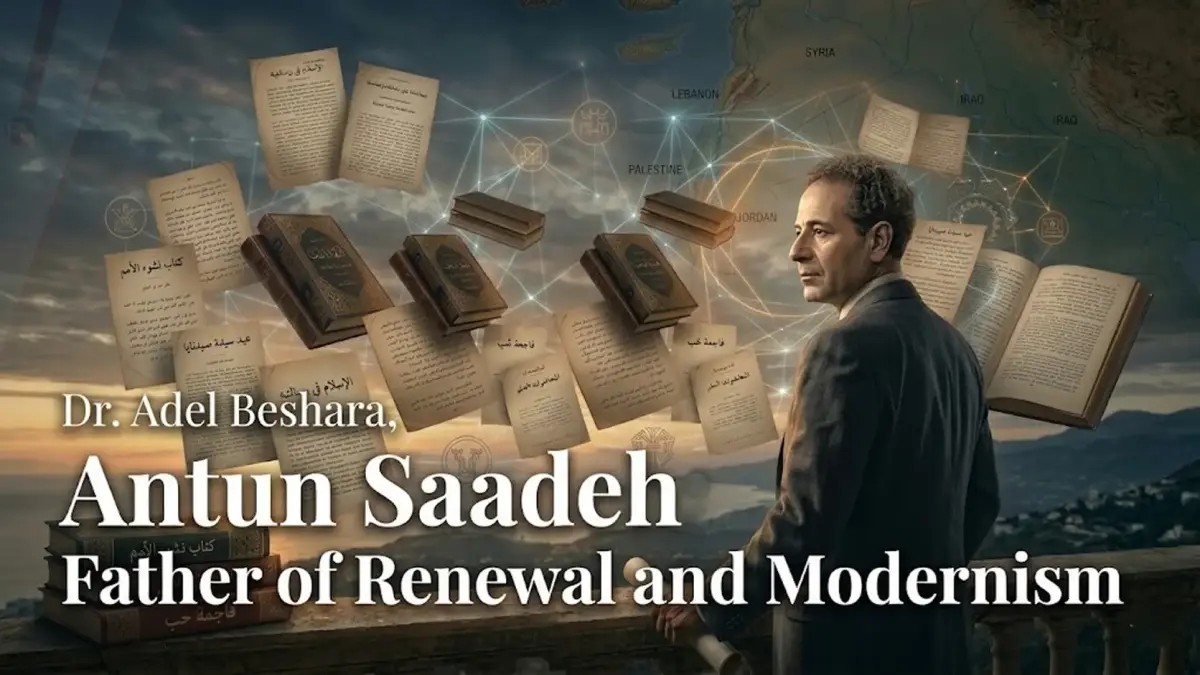
I recently encountered a scholarly study by Mohamad Maatouk that examines the life and intellectual project of Antun Saadeh. The following provides a concise critical review of this work, which originated as a doctoral dissertation and is forthcoming in revised form as a monograph:
Maatouk’s study offers a comprehensive scholarly examination of the life and intellectual development of Antun Saadeh. It systematically traces the evolution of his thought, charting his progression from an amateur journalist in the 1920s to a leading political theorist and activist in subsequent decades. As the principal architect of a fully developed national movement, Saadeh emerged as a formidable figure, distinguished by both intellectual acuity and an unwavering determination to achieve his objectives. In contrast to the established political elites of his era, he lacked both an entrenched power base and substantial financial resources. Instead, his influence derived largely from his personal charisma and his demonstrably effective leadership capacities, through which he secured a lasting impact on the political landscape.
The study delineates the intensity and scope of Antun Saadeh’s national project, highlighting his sustained efforts as both a theorist and a movement leader. Taken together, these efforts reflect a persistent commitment to articulating an ethical framework that underpinned his political and literary production, as well as a methodological openness to multiple perspectives. As the analysis progresses across chapters, Saadeh emerges as a writer of considerable force and a proponent of resolute positions that contributed to shaping—and at times reshaping—the political discourse of his era and its aftermath. Rather than conforming to the model of a conventional politician, he is more accurately understood as a political ideologue who engaged deeply with the foundational tensions of his context, demonstrating a consistent personal commitment to notions of “authenticity” and to a mode of interpretation grounded in empathetic understanding.
As Antun Saadeh’s engagement with moral and psychological complexity deepened, the scope of his intellectual and political production expanded correspondingly. He advanced increasingly comprehensive and uncompromising positions, intensified his early commitment to radical egalitarian principles, and cultivated a more pronounced appreciation for the diverse forms of artistic expression. Across these varied pursuits, Saadeh exhibited a notable consistency of purpose: in a period marked by transition and uncertainty, he articulated a guiding ideal and adhered to it with sustained resolve, pursuing its implications along multiple and often demanding trajectories without deviation.
Upon completion of this study, the reader is expected to attain a deeper appreciation of the distinctive and consequential contributions of Antun Saadeh. Among these contributions are several defining features, including but not limited to the following:
1. New discourse: Antun Saadeh did not appropriate the prevailing political idioms or operate within their restrictive conceptual boundaries. From an early stage, he recognized that the language and terminology of the dominant political discourse were ill-suited to the shifting realities and emergent challenges of the modern era. In his assessment, these discursive forms were residues of an earlier period in which religion, politics, and literature were deeply entangled, and in which the impetus for transformation was constrained by entrenched beliefs—often approaching superstition—and susceptible to manipulation by vested political interests.
In response, Saadeh sought, with marked intellectual confidence, to articulate an alternative political discourse grounded in modernist assumptions and a reconfigured mode of reasoning. This project entailed the introduction of new terminologies, the redefinition of inherited concepts, and a sustained critique of the limitations inherent in the dominant framework. Through these interventions, he enabled his contemporaries to apprehend their social and political conditions with greater analytical clarity, encouraging an understanding of reality not as a fixed or immutable given, but as a contingent state open to transformation in accordance with collective aspirations.
2. New outlook: If a single distinguishing feature may be identified in the thought of Antun Saadeh, it is his sustained pursuit of what he termed a “new outlook on life.” Unlike many of his contemporaries, who confined themselves to critiquing the prevailing Weltanschauung, Saadeh endeavoured to construct an alternative conceptual framework grounded in a systematic set of evaluative criteria and normative principles governing human activity in society. His intellectual project was both expansive in scope and ambitious in execution: the call for a renewed outlook on life and the universe stemmed not only from a conviction in the transformative potential of change, but also from his belief in its necessity for genuine progress.
Crucially, this undertaking did not rely on imitation or the uncritical adoption of external models. Rather, Saadeh drew upon endogenous resources—mobilizing local energies, national heritage, and the formative influence of historical antecedents. He regarded the cultural and historical legacy of the nation as sufficiently rich to sustain the development of a new outlook informed by a plurality of ideas, solutions, and affective commitments. In this respect, Saadeh emerges as a pioneering thinker who recognized the constitutive role of national myths and collective memory in shaping a Weltanschauung rooted in indigenous foundations.
3. New philosophy: Prior to the emergence of Antun Saadeh, two dominant philosophical orientations structured much of contemporary thought: one privileging “matter” as the primary determinant of human development, and the other its antithesis, the “spirit.” Although each framework possessed certain analytical strengths, both proved ultimately inadequate in addressing persistent human problems. In some instances, their reductive tendencies generated additional contradictions, exacerbating rather than resolving the crises they sought to explain, and contributing to conditions of profound social and intellectual dislocation.
Against this backdrop, Saadeh advanced a distinctive philosophical synthesis that sought to avoid the limitations inherent in these polarized approaches. He articulated a foundational doctrine predicated on the integration of matter and spirit as co-constitutive forces in human life, designating this synthesis al-Madrahiyyah—a neologism intended to demarcate his system and underscore its originality. This formulation positioned him outside the dominant ideological currents of his time, distinguishing his thought both from materially deterministic doctrines, particularly those associated with Karl Marx, and from spiritually inflected ideologies such as fascism and Nazism. Notwithstanding its centrality to his intellectual project, this dimension of Saadeh’s thought is frequently marginalized in critical discourse, which often privileges superficial resemblances over substantive philosophical analysis when situating him within the broader intellectual landscape of his era.
4. New meanings: Antun Saadeh rejected the prevailing definitions of foundational national and social values, regarding them as conceptually ambiguous and therefore inadequate for the construction of a viable national existence. In his view, many of these formulations were rooted in outdated and internally inconsistent assumptions that served to perpetuate a deteriorating status quo rather than facilitate the conditions for sustainable development. Some derived from sectarian religious frameworks whose historical utility had diminished, while others were imported from external contexts, reproducing the intellectual patterns, institutional logics, and cultural dispositions of their foreign origins.
In response, Saadeh undertook a systematic effort to redefine and, where necessary, reconstruct these core concepts in order to introduce greater coherence and analytical rigor into national discourse. His contributions to the conceptualization of the “nation” and “nationalism” are particularly notable for their depth and scope, as is his critical engagement with questions of race and racial purity and their relationship to nationalist thought. Operating within an environment marked by intellectual disarray and political uncertainty, Saadeh assumed the demanding task of clarifying these issues, seeking to ground the project of national renewal on what he conceived to be a more scientific and methodologically consistent foundation.
5. New literature: In alignment with his broader vision of renewal, Antun Saadeh advanced a distinctive theory of literature and literary revival. Central to this formulation is the proposition that meaningful literary renewal cannot be achieved within an unchanged social and political order; rather, it presupposes a more comprehensive transformation of life itself. Saadeh conceptualized this approach as the “literature of life,” positioning it in deliberate contrast to the “literature of books,” which, in his assessment, largely reflects prevailing values and perpetuates inherited standards and ideals.
While he recognized the significant role of literature in processes of national regeneration, Saadeh maintained that its transformative potential is contingent upon a corresponding revitalization of the broader societal context. This perspective exemplifies the integrative and systemic character of his thought, underscoring his preference for comprehensive structural change over incremental or piecemeal reform.
6. New polity: Antun Saadeh’s comprehensive project of societal renewal extended to the political domain, where it informed his articulation of an alternative model of governance grounded in what he conceived as a symbolic or expressive system of representation. He designated this model al-dīmuqrāṭiyyah al-taʿbīriyyah (“expressive democracy”), distinguishing it from conventional parliamentary forms and other prevailing democratic paradigms. At its core lies the proposition that authentic democratic practice is realized through modes of representation predicated on heightened social consciousness and a clear, collectively shared understanding of the national interest.
This formulation does not constitute a direct negation of parliamentary democracy; rather, it represents a reconfiguration that emphasizes awareness, transparency, and ethical clarity in electoral processes and in the selection of governing elites. Central to this approach is the recognition that democratic institutions cannot attain substantive efficacy within a socio-political environment structured by sectarian prejudice, racialized assumptions, and the predominance of parochial interests. In this respect, Saadeh’s model seeks to align democratic practice with a transformed social foundation capable of sustaining its normative aspirations.
The foregoing characteristics of Antun Saadeh’s intellectual project are systematically examined in this study, which offers a detailed account of the trajectory of his life and the principal ideas he advanced. Moving beyond reductive interpretations that confine Saadeh to the role of a conventional political actor—or that characterize him as an imitator of fascism or Nazism on the basis of superficial resemblances—the work provides a more rigorous and nuanced assessment of his contributions. In doing so, it foregrounds Saadeh’s status as an original thinker who engaged substantively with complex questions pertaining to human nature and the organization of social and political life.