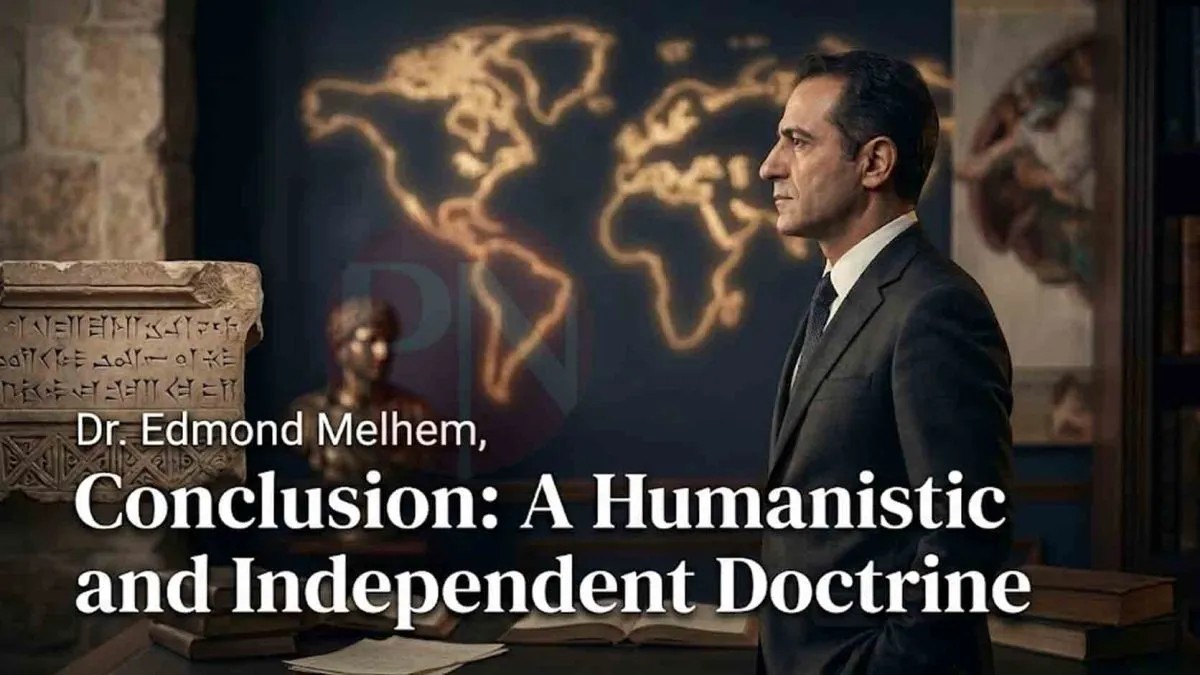
A careful reading of the writings and political thought of Antun Saʿadeh demonstrates that the claim identifying his ideology with Fascism or Nazism is not supported by evidence. While certain external similarities-such as organizational discipline or nationalist language-may invite superficial comparisons, the intellectual foundations, aims, and ethical orientation of Social Nationalism differ in essential ways from those doctrines.
At its core, Saʿadeh’s thought is grounded in a rational and social understanding of human society. He rejected racial theories, myth-based politics, and expansionist ambitions, and instead emphasized the importance of scientific thinking, social cohesion, and the objective study of historical and material conditions. His project was not built on domination or exclusion, but on the organization and advancement of society as a living, dynamic reality.[1]
A central element in this divergence lies in his conception of peace. For Saʿadeh, peace is not a passive condition nor a mere absence of war. It is a structured and ethical state that arises from justice, sovereignty, and balanced relations among nations. Internally, peace depends on unity, social harmony, and the overcoming of sectarian divisions.[2] Externally, it requires mutual respect, the rejection of imperial domination, and the recognition of each nation’s right to existence and development. In this sense, peace and justice are inseparable.[3]
At the same time, Saʿadeh did not advocate submission or acceptance of injustice in the name of peace. His writings make clear that a stable international order cannot be built on the deprivation of peoples or the denial of their rights. Rather, genuine peace emerges when nations are free, organized, and capable of engaging with one another on equal terms. This perspective places sovereignty not in opposition to cooperation, but as its necessary foundation.
Beyond the political dimension, Saʿadeh’s thought carries a broader humanistic vision. He viewed national revival as part of a larger contribution to humanity, not as an end in itself. His philosophy sought to elevate culture, promote rational understanding, and encourage interaction among societies in ways that advance human progress. In contrast to ideologies that glorify conflict and domination, he proposed a framework based on cooperation, cultural development, and shared responsibility for the future of humanity.
This humanistic orientation becomes even clearer when examined through the philosophy of al-Madrahiyyah, which constitutes the intellectual core of his project. This philosophy is explicitly goal-oriented: it seeks not only to reform a fragmented and weakened society but also to transform it into a unified, productive, and dignified national community. It aims to establish a comprehensive renaissance that reshapes social, economic, political, and cultural life based on justice, coherence, and creative interaction. In this framework, national revival is inseparable from human advancement.[4]
Saʿadeh’s project thus operates on two interconnected levels. First, it seeks to restore the vitality of Syrian society by grounding it in a unified vision of life, interests, and destiny, supported by a just social and economic order. Second, it aspires to restore what he described as the “Syrian genius” to its role in contributing to the progress of humanity, particularly in overcoming the crises, conflicts, and destructive wars that have marked modern history.[5] His rejection of both purely materialist and purely spiritual doctrines reflects an attempt to transcend the ideological conflicts that have divided the modern world, proposing an integrated view of human life.
Within this broader vision, the ultimate aim of political and social organization is clearly defined. As Saʿadeh himself affirmed, the purpose of establishing a new system is “to make life nobler, better, and more beautiful,”[6] and “life and its beauty and goodness are the ultimate end.”[7] This emphasis reveals a philosophical orientation that places human flourishing—not power, domination, or expansion—at the centre of political life. Peace, in this sense, is not merely a condition of stability, but the natural outcome of a just, harmonious, and elevated human existence.
Taken as a whole, Saʿadeh’s ideology represents an independent intellectual project that cannot be reduced to European fascist categories. It is a coherent attempt to articulate a modern theory of society and international relations grounded in reason, justice, sovereignty, and human dignity. It rejects domination in all its forms while affirming the creative role of nations in building a better world.
In synthesis, the previous three parts on global peace demonstrate that Saʿadeh’s thought advances a unified vision in which national revival, social reform, and global peace are inseparable: a vision that begins with the organization and elevation of society, extends to the affirmation of sovereignty and just international relations, and ultimately culminates in a humanistic mission to contribute to “a better life in a more beautiful world,”[8] founded on freedom, cooperation, and the highest values of human civilization.
[1] See Antun Sa´adeh, Nushu’ al-Umam (The Genesis of Nations), Beirut: SSNP- Cultural Department, 1976.
[2] Refer to his reform principles in Al-Muhadarat al-'Ashr (The Ten Lectures).
[3] Antun Saʿadeh. Complete Works, vol. 7, 1944 – 1947, “A dimension of the post-war political struggle” (ناحية من الحرب السياسية بعد الحرب)
[4] Refer to my work work: SURVIVAL and REVIVAL- An analytical approach to Sa’adeh's national thought, Beirut, 2024, pp. 125-130.
[5] Antun Sa’adeh. The Complete Works, Vol 3- 1938-1939, "The National Social Doctrine” (from the leader's speech at the national meeting at the 'Sharaf wa Wattan club in Buenos Aires in December 1939.
[6] Antun Sa’adeh. Al-Muhadarat al-‘Ashr (The ten Lectures), op. cit., p. 173.
[7] Ibid.
[8] Antun Sa´adeh. As-Sira’ al-Fikri fil-Adab as-Suri (Intellectual Struggle in Syrian Literature), op. cit., p. 69.