Introduction
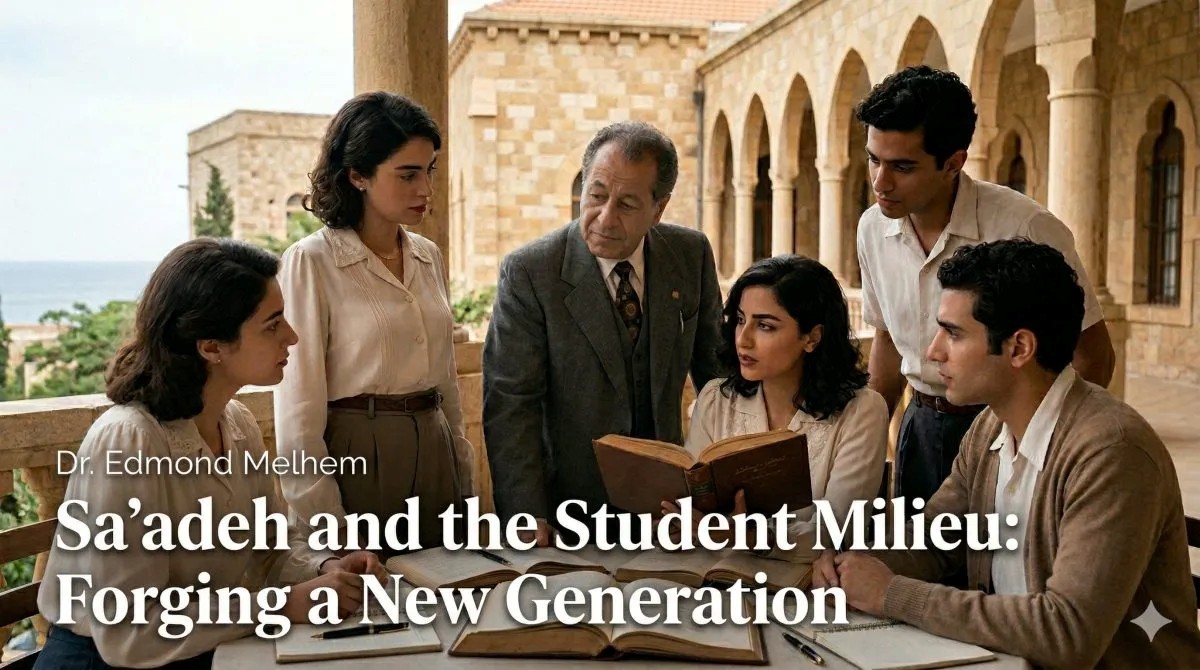
Any attempt to grasp Antoun Sa’adeh’s intellectual and political project must begin with a fundamental recognition: his national endeavour neither emerged in isolation from society nor was it initially directed toward established political elites. Rather, it took root within a vibrant and receptive milieu—that of students.
Sa’adeh began articulating and disseminating his ideas among students at the American University of Beirut, where a rising generation was already in search of meaning, direction, and a path beyond the fragmentation and uncertainty that marked the life of the nation. Within this milieu, his thought found not merely an audience, but a living force—capable of engaging with it, carrying it forward, and translating it into action.
At an early stage, Sa’adeh gathered around him a circle of university students and engaged them in the Central Cultural Forum he founded in 1937. Through this forum, he introduced and expounded the Party’s principles and ultimate aims. Following his return from forced exile, he further deepened this process of intellectual formation through the well-known series of ten lectures, in which he systematically elaborated the Party’s doctrine and worldview.
From these beginnings, the Social Nationalist Movement emerged—initially as a student-centered initiative, and subsequently as a broader popular movement. Students were not merely participants in this process; they constituted its very foundation. In Sa’adeh’s vision, they embodied the “new souls” capable of transcending the burdens of the past and confronting the challenges of the present with clarity, discipline, and purpose.
It is therefore no coincidence that some of Sa’adeh’s most significant speeches were addressed to students: at the American University of Beirut, at the National School of al-Nāshiʾa in Fraykeh, and in his address to the students of Damascus. In these addresses, he articulated not only a call to action, but a comprehensive vision of the student’s role in shaping the future.
This series offers a reading of these speeches as a coherent intellectual and educational project—one that unites rational persuasion with inspiration, and seeks to form a new generation grounded in knowledge, awareness, and ethical commitment.
I Students in Sa’adeh’s Thought – The Starting Point of Renaissance
Students constitute a socially conscious, dynamic, and sensitive stratum—arguably the most responsive to the sufferings and aspirations of the people, to the challenges confronting society, and to the imperatives of independence, sovereignty, and social liberation. In essence, they form the backbone of national transformation, the architects of renaissance, and the leaders of the future.
For this reason, political movements have consistently sought to attract students and youth. Yet what distinguishes Sa’adeh’s approach is that he did not merely seek their support; he discerned in them the very foundation of a new national project.
The Social Nationalist Movement itself emerged among students at the American University of Beirut before expanding into a broader popular movement. From the outset, Sa’adeh recognized that students were not simply a supportive element, but a formative force capable of carrying a new consciousness into the wider society.
This early engagement was neither incidental nor informal. Sa’adeh gathered around him a committed circle of university students and involved them in an organized intellectual setting—most notably the Central Cultural Forum he established in 1937. Within this framework, students were not passive recipients, but active participants in a process of intellectual formation through which the principles of the Party and its broader aims were clarified, examined, and internalized.
He described them as “new souls” and “bearers of a new awareness,” viewing them as the element capable of breaking free from inherited constraints and confronting emerging challenges with a renewed spirit.
Sa’adeh placed profound trust in their intellectual capacities and in their freedom of will—the will to seek a new and meaningful life. He saw in them the makers of an active and liberated force, capable of moving the nation from confusion to clarity, and from stagnation to progress.
It is within this framework that he addressed them in a series of key speeches delivered at the National School of al-Nāshiʾa, at the American University of Beirut, and in Damascus—speeches that may be read as natural extensions of that earlier formative endeavour.
In the next article, we turn to the language of these speeches—examining how Sa’adeh wove together reason and inspiration to shape both mind and spirit.