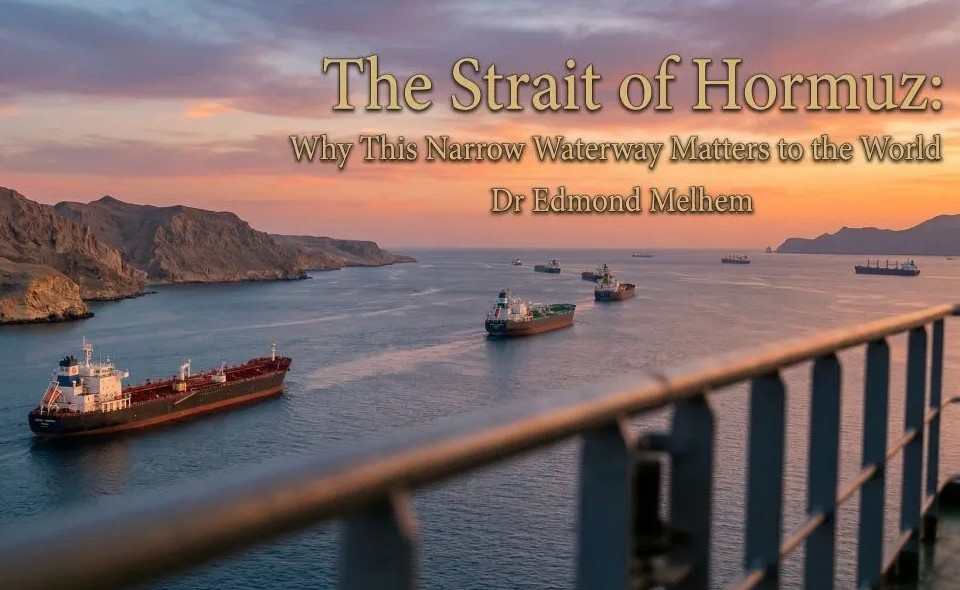
Rising tensions in the Middle East have once again drawn global attention to the Strait of Hormuz, one of the most strategically important waterways in the world.
In recent weeks, threats to commercial vessels and attacks on ships have severely disrupted maritime traffic through the Strait. Many shipping companies have begun avoiding the route, and insurers have raised premiums dramatically because of the risks. Although no internationally recognized legal blockade has been declared, analysts increasingly describe the situation as an “effective closure” of the Strait.
Because a large share of the world’s energy exports passes through this narrow passage, the crisis has raised serious concerns about global oil supplies, international trade, and the stability of the world economy.
Where Is the Strait of Hormuz?
The Strait of Hormuz is a narrow waterway that connects the Persian Gulf to the Arabian Sea.
It lies between:
• Iran to the north
• Oman and the United Arab Emirates to the south
At its entrance and exit, the Strait is about 50 kilometres wide, while its narrowest point is roughly 33 kilometres across. Despite its small size, it is deep enough to accommodate the world’s largest oil tankers.
Because of its location, the Strait serves as the main maritime gateway for energy exports from the Gulf region to global markets.
Why Is It So Important?
The Strait of Hormuz is widely considered the most important oil transit chokepoint in the world.
On average, about 20 million barrels of oil per day pass through the Strait—roughly one-fifth of global oil consumption. The value of the energy transported through this narrow corridor amounts to hundreds of billions of dollars each year.
The oil shipped through the Strait comes from several major producers, including:
• Saudi Arabia
• Iraq
• Kuwait
• Qatar
• United Arab Emirates
• Iran
Every month, roughly 3,000 ships pass through the Strait carrying crude oil, liquefied natural gas, and other goods.
Because such a large share of the world’s energy supply depends on this narrow waterway, even limited disruptions can quickly affect global markets.
The Global Impact of Disruption
A prolonged disruption to shipping through the Strait of Hormuz could have major economic consequences worldwide.
Rising energy prices
If oil and gas exports from the Gulf cannot reach international markets, global supply decreases. This typically leads to a sharp rise in oil prices, which affects transportation, electricity generation, and industrial production.
Higher energy costs eventually translate into higher prices for goods and services around the world.
Pressure on major economies
Several of the world’s largest economies depend heavily on oil transported through the Strait, including:
• China
• India
• Japan
A prolonged disruption could slow industrial activity and increase inflation in these countries, with ripple effects across global supply chains.
Rising shipping and insurance costs
Even without a formal blockade, the threat of attacks can make the route too dangerous for commercial vessels. Insurance companies may refuse coverage or charge extremely high premiums for ships entering the area.
When that happens, shipping companies often choose to avoid the route entirely, further reducing the flow of oil and gas to global markets.
How the Crisis Affects Iran
While disrupting the Strait may give Iran a powerful strategic tool, it also carries significant risks for the country itself.
Loss of oil revenue
Iran exports a large portion of its oil through the same waterway. If maritime traffic remains restricted, the country could struggle to sell its own oil abroad, reducing government revenue and putting additional pressure on the national economy.
Risk of military escalation
Any attempt to block such a vital global trade route could provoke a strong response from major powers, particularly the United States and its allies. Such a response could involve strikes against Iranian naval forces or military infrastructure.
Strain on economic partners
Major Asian economies—especially China and India—are important buyers of Iranian oil. A prolonged disruption could complicate Iran’s relations with these key partners if their energy supplies are threatened.
For these reasons, analysts often describe closing the Strait as a high-risk strategy that could harm Iran as well as its adversaries.
Who Might Benefit?
Although the disruption would harm many economies, some countries and industries could benefit from rising energy prices.
Oil producers outside the Gulf
Countries that export oil but do not depend on the Strait of Hormuz could gain from higher prices. These include the United States, Russia, Canada, and Norway.
When global supply declines, the value of oil produced elsewhere tends to increase.
Energy companies
Large international oil and gas companies also benefit when prices rise due to supply disruptions. Higher prices increase the value of existing production and can boost profits across the energy sector.
Countries with alternative export routes
Some Gulf states have built pipelines that bypass the Strait. For example, Saudi Arabia can export part of its oil through pipelines to ports on the Red Sea, while the United Arab Emirates ships some of its oil from the port of Fujairah on the Gulf of Oman.
Although these alternatives cannot replace the full capacity of the Strait, they allow limited exports to continue even during periods of disruption.
Strategic leverage for Iran
Despite the risks, the crisis also gives Iran a form of geopolitical leverage. Because the Strait of Hormuz is so vital to global energy trade, any threat to shipping there quickly becomes a matter of international concern.
A Long-Recognized Strategic Resource
The geopolitical importance of Middle Eastern oil was recognized long before the current crisis. In 1949, the Syrian thinker Antun Saadeh wrote that petroleum concessions could serve as a powerful international weapon in global politics. Writing about negotiations surrounding regional oil pipelines, he argued that control over energy resources could influence the policies of major powers.
More than seventy years later, the tensions surrounding the Strait of Hormuz demonstrate how closely the global economy remains tied to the energy resources of the Middle East and to the routes that carry them.
A Narrow Passage With Global Consequences
The Strait of Hormuz is only a few dozen kilometres wide, yet it plays a central role in the global economy. It connects the Gulf region's energy resources with markets across Asia, Europe, and beyond.
For this reason, instability in this narrow waterway is watched closely around the world. Any prolonged disruption could reshape energy markets, strain international relations, and affect economies far beyond the Middle East.
In today’s interconnected global system, the fate of this small maritime corridor can influence the stability of the entire world economy.